furniture music in swift and metal
Four days ago I wrote about music without audio files, a 3.6 KB Web Audio synthesizer that writes hold music one bar at a time inside an Ando Jam. Once that engine worked, a harder question followed: what happens if you pull the same idea out of a browser tab and build a dedicated desktop instrument for working, reading, and resting, with no Electron shell, no cloud streams, and no subscription?
The first Mac build was 2.4 MB of pure synthesis. Once I added 46 public-domain studio samples, a Factor Oracle, a Velvet-Noise reverb chamber, six 120 Hz Metal shaders, and native 8-language Apple localization, Satie (v4.1.1, MIT licensed, Apple notarized) landed at 10 MB on macOS—and the same shared AcousticCore engine now runs natively on iPhone and iPad on the App Store. Both apps ask for zero permissions, make zero network requests, and compile in Swift 6 and Metal with zero third-party packages.
The interactive exhibits below synthesize audio in your browser with the Web Audio API so you can hear the Factor Oracle jumps, the Velvet-Noise diffuser, the 14.40 Hz shimmer fix, the rain field, and the circadian bronze bowls right in this page.
- notarized macOS app (.dmg)
- 10 MB
- unique 32-bar passes (256 bars)
- 7 / 7
- nocturnal blue reduction
- −90.4%
- third-party packages / permissions
- 0 / 0
The inspirations
Four traditions shaped Satie, two in sound and two in sight.
- Japanese kankyo ongaku (1980s environmental music). Hiroshi Yoshimura's Green and Music for Nine Post Cards, alongside Midori Takada's percussion studies, proved that sparse acoustic timbres spaced with ma (negative space) hold a room together better than dense pads. That lineage drives Soft Light, Rain & Glass, and Gymnopédie.
- Brian Eno's asynchronous tape loops. In Music for Airports (1978), Eno cut tape loops of incommensurate lengths so phrases drifted in and out of alignment over hours. Satie borrows that structure with prime-length macro cycles (5, 7, 11, and 13 bars) layered underneath a Factor Oracle automaton.
- James Turrell's skyspaces and Hiroshi Sugimoto's seascapes. Most audio visualizers flicker like a nightclub equalizer and wreck concentration. Turrell's Aten Reign strips out hard spatial edges so the eye rests in slow luminous drift (06 Oculus). Sugimoto's long-exposure Seascapes reduce a room to one calm horizon over dark water (05 Horizon).
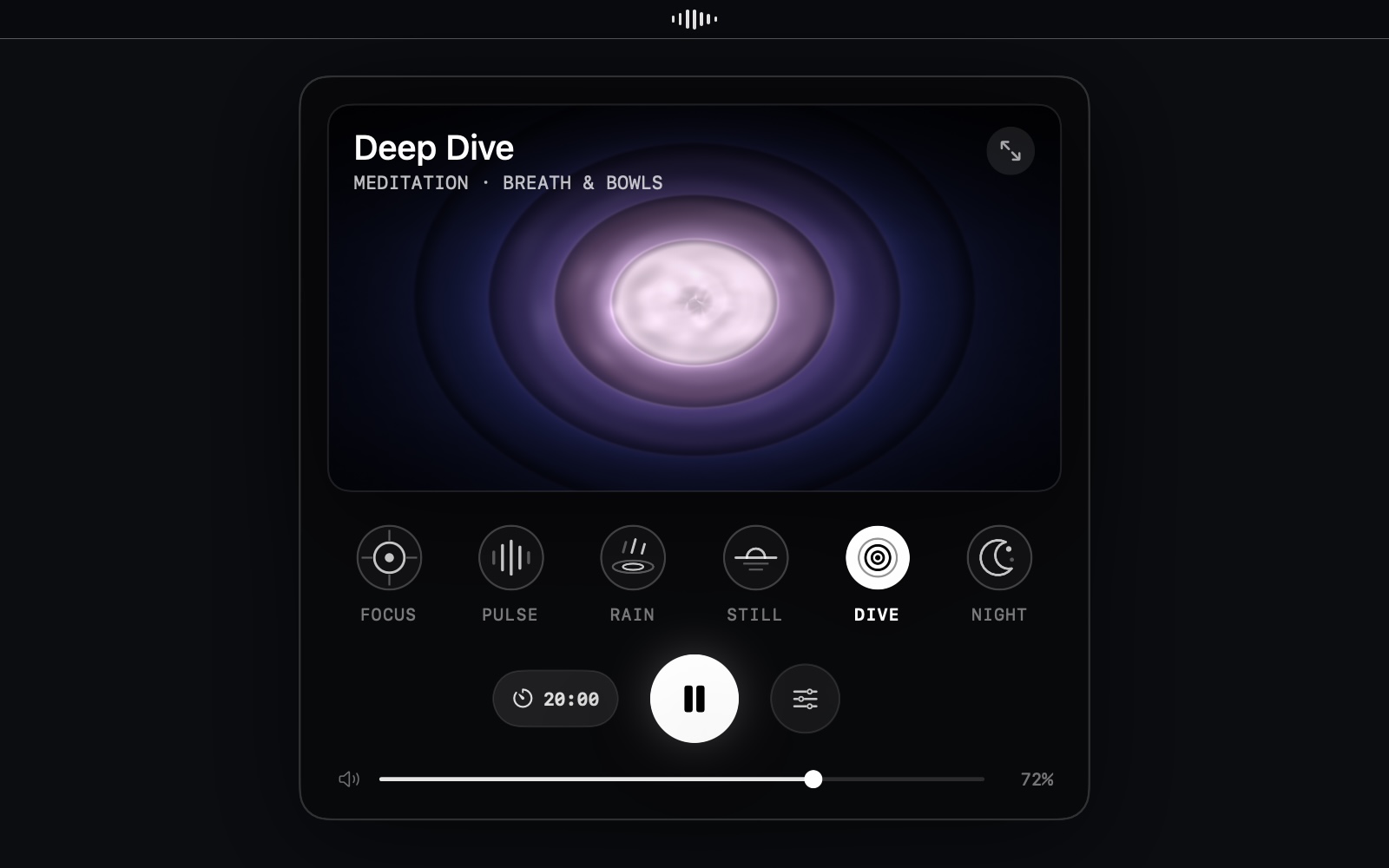
- Dieter Rams's Braun instruments and CRT test equipment. The menu bar panel holds six monochrome geometric glyphs, one centered play button, and one options drawer. When you expand into Studio view, the technical presets (01 The Circuit, 02 Ecology Wall, and 03 Phosphor Scope) read like a calibrated Tektronix oscilloscope and spectrum analyzer rather than a media player.
How Satie compares to other products
Focus audio already has strong commercial products, and they are worth judging honestly. Brain.fm funds real academic neuroscience, including the 2024 Communications Biology fMRI and EEG study on rapid beta-range modulation. Endel runs a polished cross-platform stem engine with artist collaborations and a broad catalog. Portal records spatial field audio in real national parks. Spotify playlists require no new software if you already keep a tab open.
Satie makes a different set of bets. It ships as a single 10 MB offline binary with no account, no subscription, no network calls, and zero system permissions. Because it generates sound from 46 public-domain CC0 studio samples and real-time physical DSP instead of streaming pre-mixed tracks, it never hits a loop seam, works in airplane mode indefinitely, and lets you inspect every filter coefficient on GitHub.
| Product | Audio engine | Offline / Footprint | Visuals | Price & source |
|---|---|---|---|---|
| Satie | 46 CC0 studio samples + live physical DSP, Velvet-Noise FDN, Factor Oracle | 100% offline · 10 MB macOS / 12 MB iOS & iPadOS | 6 × 120 Hz Apple EDR Metal shaders + circadian night mode | Free · MIT open source · 0 permissions |
| Endel | Adaptive cloud/local stem assembly (Pacific engine) | Web, mobile, desktop (~100–250 MB) · account required | Stylized ambient loops (SDR) | Subscription · proprietary |
| Brain.fm | Pre-composed tracks with patented 14–16 Hz amplitude modulation | Streaming / cached downloads · account required | Minimal timer UI | Subscription · proprietary |
| Portal | Spatial field recordings from real locations | Large audio packs (hundreds of MB to GB) | 4K location video loops + Philips Hue | Subscription · proprietary |
| Noisli / Spotify | Static noise loops or streamed playlists | Browser or ~300 MB Electron desktop app | Album art or color wash | Freemium / subscription |
What the science supports, and what I cut
Before writing the v4 audio and visual upgrades, I audited the 2022 to 2026 peer-reviewed literature across psychoacoustics, slow-paced breathing, and display photobiology. Half of wellness audio marketing collapses under a quick PubMed check. Separating replicated results from hype drove five concrete engineering calls in Satie.
| Mechanism | Peer-reviewed evidence | Decision in Satie |
|---|---|---|
| 14–16 Hz beta AM | Woods et al. (Communications Biology, 2024) found stronger fMRI executive/salience activation, EEG phase-locking, and sustained attention gains, largest in listeners with attentional difficulties. | Built into Kinetic Pulse at 14.40 Hz, phase-locked 8:1 to 108 BPM on harmonic pads and wet tails so it shimmers without chopping dry hits. |
| 0.1 Hz slow breathing | Extended-exhale respiration trials (Balban et al., Cell Reports Medicine, 2023) and 2024–2025 ~0.1 Hz RSA RCTs confirm ~5.5–6 bpm extended-exhale breathing maximizes baroreflex synchrony, with fixed 0.1 Hz matching individualized calibration. | Drives Deep Dive's 8.5 to 5.5 bpm descent (42% inhale, 58% exhale), coupled to bowed cello, cedar wind, and 06 Oculus, with optional Apple Watch HRV closing the loop. |
| Lyrics & colored noise | Lyrics hurt reading and verbal working memory (d ≈ −0.3; Souza & Barbosa, 2023). White/pink noise helps ADHD (g ≈ +0.25) but slightly hurts neurotypicals (g ≈ −0.21; Nigg et al., JAACAP, 2024). Brown noise has zero clinical RCTs. | Zero vocals everywhere. Rain and Brown Noise stay off by default so broadband noise is never forced on listeners it slows down. |
| Melanopic screen light | 460–480 nm blue light hits retinal ipRGCs and suppresses melatonin; the CIE expert consensus (Brown et al., PLOS Biology, 2022) sets evening targets below 10 melanopic EDI lux. | Post-20:00 shader shift strips 90.4% of blue emission in 06 Oculus and warms all six presets into 2200 K ember. |
| Binaural beats | Ingendoh, Posny & Heine (PLOS ONE, 2023) reviewed 14 strict EEG studies: 8 contradicted brainwave entrainment, 5 supported, 1 mixed. | I refuse to market brainwave entrainment. Deep Dive keeps a slight post-matrix stereo micro-detune only as a warm spatial width cue. |
One audio thread, zero allocations
Real-time audio has one unforgiving rule: the Core Audio render callback can never allocate heap memory, never acquire a mutex, and never block on Swift or Objective-C runtime locks. Drop a single 10 millisecond buffer on a 48 kHz stream and the listener hears an instant crackle.
Satie enforces a hard wall between composition, synthesis, and GPU rendering. A background producer composes harmonic bars ahead of time and writes note structs into a fixed-capacity 16-bar lock-free single-producer single-consumer queue (LockFreeBarQueue). UI controls cross threads through Swift 6 Synchronization.Atomic scalars. Inside the Core Audio render block, FocusSoundEngine drains pre-built events, reads 46 decoded CC0 samples with 4-point Hermite cubic interpolation, sums physical modal voices, runs the Velvet-Noise FDN chamber and mastering bus, and mirrors output samples into a second lock-free stereo ring buffer for the visualizer.
When you switch soundscapes mid-session, Satie never cuts the audio buffer. softModeTransition() dips only the dry instrument excitation over 220 ms while keeping the 8×8 FDN chamber and 14-grain Beads cloud alive, so the decaying hall tail of one world dissolves into the next.
Infinite form with a Factor Oracle
In the first version of Soft Light, a 32-bar harmonic progression repeated with local note swaps. That holds up for ten minutes in a lobby, yet over a three-hour coding session your ear predicts bar 17 before it arrives. Unconstrained Markov chains solve repetition by wrecking form: the music wanders and loses its sense of home.
The fix comes from IRCAM's OMax and Somax2 research: a linear-time O(m) Factor Oracle (Allauzen, Crochemore, and Raffinot, 1999) built over a curated multi-climate harmonic corpus. Forward edges play written bars in order, preserving human voice-leading. Suffix links connect states that share the same harmonic history, acting as recombination portals. A lightweight Symbolic Constraint Grammar guards every jump so the oracle enforces tonic gravity, caps repeated chords (maxHold), and balances home phrases (Climate A) against open expansions (Climate B).
for i in 0..<m {
    let sym = symbols[i]
    let nextState = i + 1
    trans[i][sym] = nextState

    var k = sLink[i]
    while k >= 0 && trans[k][sym] == nil {
        trans[k][sym] = nextState
        k = sLink[k]
    }

    let targetSuffix = k < 0 ? 0 : trans[k][sym]!
    sLink[nextState] = targetSuffix
    rev[targetSuffix].append(nextState)
}
Across 256-bar stress tests (around 14 minutes of continuous generation per mode), every scored world produces 7 out of 7 unique 32-bar passes, 64 to 72 grammar-checked suffix jumps, 50% to 65% Climate B occupancy, and 100% key purity. Phrases you heard in minute five return reframed in hour two.
Three acoustic fixes measured in tests
It is easy to fool yourself on laptop speakers. Satie ships with 22 automated release tests in AcousticCoreTests.swift that render multi-second stereo audio offline and assert exact spectral, phase, and CPU invariants. Three concrete bugs showed up in headphones or tests and forced DSP rewrites. You can audition before and after for all three in Figure 3.
1. Replacing a metallic reverb with a zero-DC Velvet-Noise FDN
Early versions used a hand-tuned 8×8 Walsh-Hadamard feedback delay network (FDN). On felt piano transients, the first 40 milliseconds sounded sparse and metallic because eight delay lines take time to build echo density. Following Fagerström, Alary, Schlecht, and Välimäki (DAFx-2020), I placed a 32-tap zero-DC Optimal Velvet-Noise early-reflection diffuser ahead of a delay-proportional colorless 8×8 orthogonal FDN. Each of the four distance bands sums four +1 and four −1 prime-jittered taps: exact DC cancellation and zero inner multiplications.
// Exact 4 (+1) and 4 (-1) prime-jittered taps per band: zero DC, zero inner multiplies.
let vnL0 = erBufL[(w - 211) & m] - erBufR[(w - 281) & m]
         + erBufL[(w - 359) & m] - erBufR[(w - 431) & m]
         - erBufL[(w - 503) & m] + erBufR[(w - 571) & m]
         - erBufL[(w - 619) & m] + erBufR[(w - 661) & m]
Measured on the impulse response in release tests: early Dirac echo density jumped to 19.5%, early stereo correlation dropped to −0.014 (wide, diffuse imaging), late tail spectral flatness reached 0.761, and DC offset settled to 0.000003.
2. Fixing the headphone buzz in Kinetic Pulse
After reading Woods and Loui's 2024 paper on rapid beta-range modulation, my first implementation put a 15.0 Hz sine modulator at 34% to 42% depth across dry instruments in Kinetic Pulse at 104 BPM. In headphones, it felt awful. Because 15.0 Hz is irrational against 104 BPM (1.733 Hz), the modulation beat asynchronously against the groove, vibrating hard in the ear canal like a broken tremolo pedal.
The fix took three changes. First, I nudged the tempo to 108 BPM and locked the shimmer frequency to 14.40 Hz (an exact 8:1 beat subdivision: 108 / 60 × 8 = 14.40 Hz). Second, I moved the modulation off dry attacks and onto the harmonic pad and reverb halo with a 36° stereo phase soften. Third, I softened the kick to a round 60 Hz felt thump, smoothed the optical sidechain attack to 16 ms at −1.4 dB, and capped the synth filter below 2.75 kHz fused with CC0 vibraphone. Broadband roughness dropped 12× from 34% down to 2.82% while preserving +11.26 dB SNR right at 14.40 Hz.
3. Killing the subliminal rain loop
Even a 3-second crossfaded studio rain recording gives itself away after five minutes. Your ear locks onto one drop cadence and hears it return every 18.5 seconds. Measuring autocorrelation across lags from 2 to 22 seconds showed a sharp peak at r = 0.6023. Replacing the loop with StochasticRainField (three asynchronous random-offset windows layered with synthetic micro-drop transients) dropped peak autocorrelation 8.2× to r = 0.0738, flat against the noise floor while keeping organic droplet kurtosis.
James Turrell, Apple EDR, and 480 nm light
When I added Deep Dive (a breath-paced meditation mode descending from 8.5 to 5.5 bpm over bowed cello and bronze singing bowls), the first visual draft was an iridescent prism. It looked flashy in a screenshot and felt exhausting after thirty seconds of breathing. Attention Restoration Theory calls the target state soft fascination: slow luminous fields with no sharp edges for the visual cortex to parse.
That led to 06 Oculus, modeled on James Turrell's Aten Reign skyspace at the Guggenheim. Four recessed plaster-like elliptical tiers dilate (+3%) on your inhale and settle on your exhale. Struck singing bowls cast pitch-locked Faraday standing-wave caustics across the central skylight aperture, then return to silence during ma gaps.
Two graphics choices matter on MacBook Pro XDR and iPhone OLED displays:
- 16-bit Apple EDR + 64×64 Ulichney blue noise. Standard 8-bit SDR shaders clamp at 1.0 and leave concentric banding across dark vignettes on high-contrast OLEDs. Satie renders all 11 Metal pipelines into
rgba16FloatwithextendedLinearDisplayP3, lifting only small emissive peaks (the skylight center, CRT electron beam core, candlelight ink rims) up to1.40×SDR white while keeping 68.6% of the canvas near true black. Before output, every shader samples a bundled 64×64 Ulichney Void-and-Cluster spatiotemporal blue-noise tile (+44.44 dBhigh-pass 2D DFT ratio), erasing gradient stair-stepping with zero visible grain. - Fixing my own melanopic bug. The first daytime Oculus drifted into cool cyan (470 to 490 nm) as meditation deepened, sitting right on top of the retinal ipRGC melanopsin peak that suppresses evening melatonin. After 20:00 local time, Satie shifts every shader into a 2200 K ember palette, cutting blue emission by 90.4% to bring evening sessions closer to the CIE 10 melanopic EDI lux threshold. Actual exposure depends on screen brightness and distance.
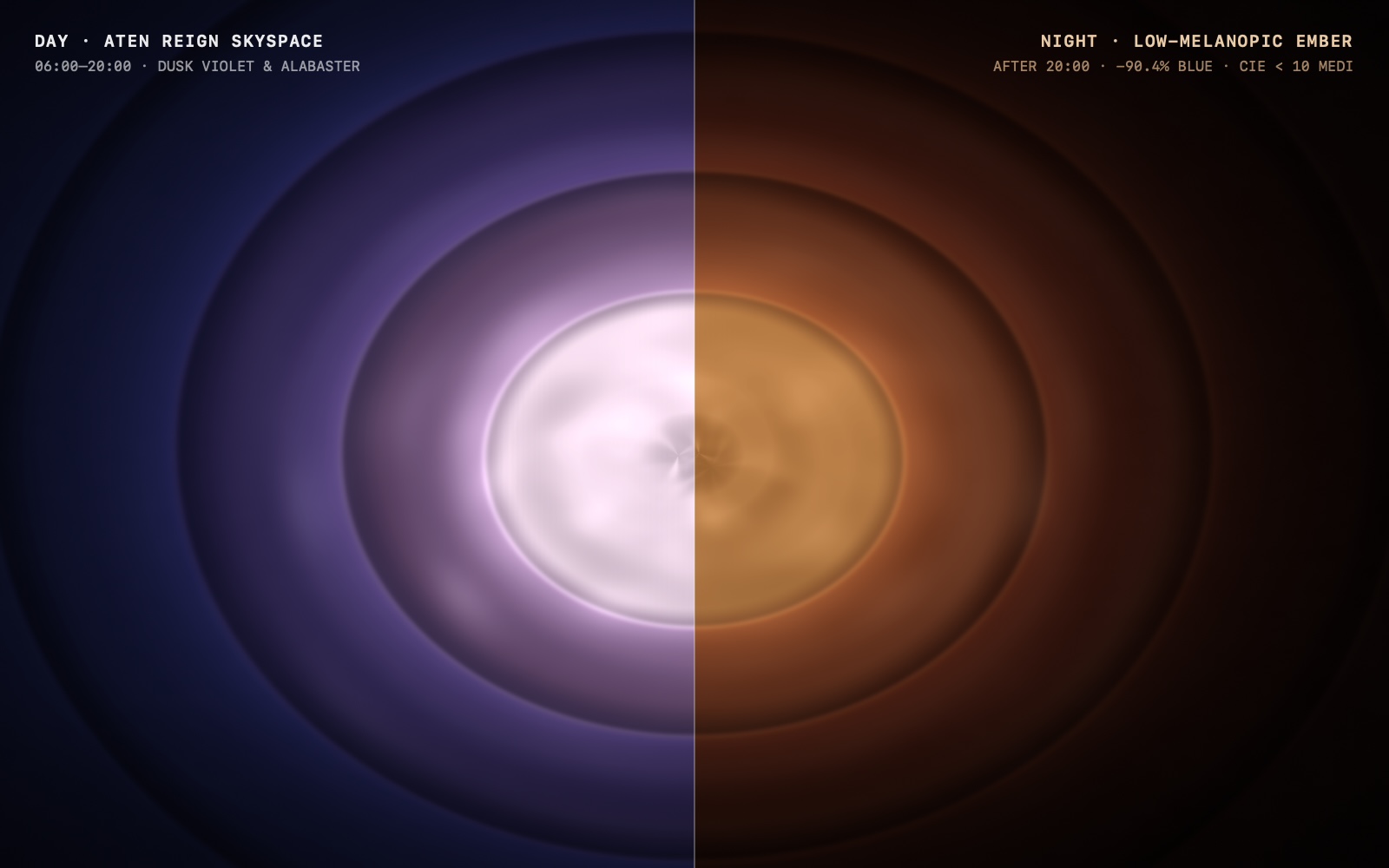
oculusFragment at 2× Retina in rgba16Float extended linear P3. Left: 06:00 to 20:00 dusk violet and alabaster. Right: after 20:00, blue channel energy drops 90.4% while keeping the same four-tier depth geometry and breath dilation.
The other five Metal presets share the same linear-P3 EDR pipeline, blue-noise dither, and post-20:00 warmth shift, each tuned to its paired world. Select a plate below (or click the image) to inspect all five Retina Metal captures:
The formal proof that missed a MetalKit bug
This was the sharpest lesson of the build. Early on, clicking Expand from the menu bar occasionally opened a Studio window whose Metal canvas sat frozen.
Instead of adding random timers, I wrote a formal TLA+ specification of the Studio window and display-link lifecycle and ran the TLC model checker across all reachable states. TLC caught four real bugs: SwiftUI 250 ms telemetry refreshes thrashing updateNSView, synchronous orderOut during fullscreen exit creating a zombie Space, reopening a minimized window without deminiaturize, and post-sleep wake leaving a dead display link. I fixed all four, compiled the verified transition table into StudioLifecycleMachine.swift (0 violations across 6 safety and liveness invariants), and shipped v4.0.0.
Ten minutes later, clicking Expand still froze the Studio window.
To isolate the freeze, I wrote a 90-line macOS reproducer cycling a single cached window (isReleasedWhenClosed = false) through three states: first open, hide with orderOut then reopen, and close with NSWindow.close() (what happens when you press ⌘W or click the red button) then reopen. The output on macOS 26.5.1 settled it in two seconds:
- Cycle 1 (first open):
MTKViewdrew 32 frames. - Cycle 2 (
orderOut→ reopen):MTKViewdrew +75 frames. - Cycle 3 (
win.close()→ reopen):MTKView.isPausedreportedfalse, the window was visible and unoccluded, andMTKViewdrew +0 frames forever.
Inside MetalKit, MTKView still uses the deprecated CVDisplayLink. When AppKit posts NSWindow.willCloseNotification, MTKView tears down that internal display link and never recreates it if the same cached window is later ordered back on screen. Worse, my effect list called setActive(true) one line before orderFront while win.isVisible was still false.
In v4.0.1, I deleted MTKView. AcousticMetalView is now a plain NSView that owns its CAMetalLayer and drives frames with Apple's CAMetalDisplayLink (attached to .main in .common runloop mode through a weak proxy to prevent retain cycles). On willClose, didMiniaturize, or system sleep, it invalidates the display link. On every open or wake, it builds a fresh one after ordering the window onto the active Space (.moveToActiveSpace).
private func syncDisplayLink(forceRecreate: Bool) {
    guard desiredActive, let win = window, !isHidden, !win.isMiniaturized, win.isVisible else {
        teardownDisplayLink()
        return
    }
    if forceRecreate { teardownDisplayLink() }
    configureEDRLayer()
    updateDrawableSize()
    if displayLink == nil {
        let proxy = MetalDisplayLinkProxy(owner: self)
        let link = CAMetalDisplayLink(metalLayer: metalLayer)
        link.delegate = proxy
        link.add(to: .main, forMode: .common)
        self.displayLinkProxy = proxy
        self.displayLink = link
    }
    displayLink?.isPaused = false
}
In the same stress harness across eight consecutive cycles of win.close(), orderOut(), and live window resizes, CAMetalDisplayLink rendered 271 frames with 0 failures. Removing three dead @Published properties that had been firing inside the render callback also cut four unnecessary SwiftUI layout passes per second.
Satie on iPhone, iPad, and the rest of Apple Silicon
Because the synthesis, DSP, Factor Oracle, and formal state machine live in a single zero-UI Swift package (AcousticCore), the macOS menu bar app is only one shell around the engine. Satie for iPhone and iPad is now live on the App Store (12.0 MB universal binary for iOS 18+ and iPadOS 18+), compiling the exact same 48 kHz Core Audio render thread, 46 CC0 samples, and all 11 Metal shader pipelines without duplicating a line of DSP. The App Store currently carries version 3.1.0, with five worlds in English; the rest of this section describes the iPhone build in the repository, which adds Deep Dive and the features below.
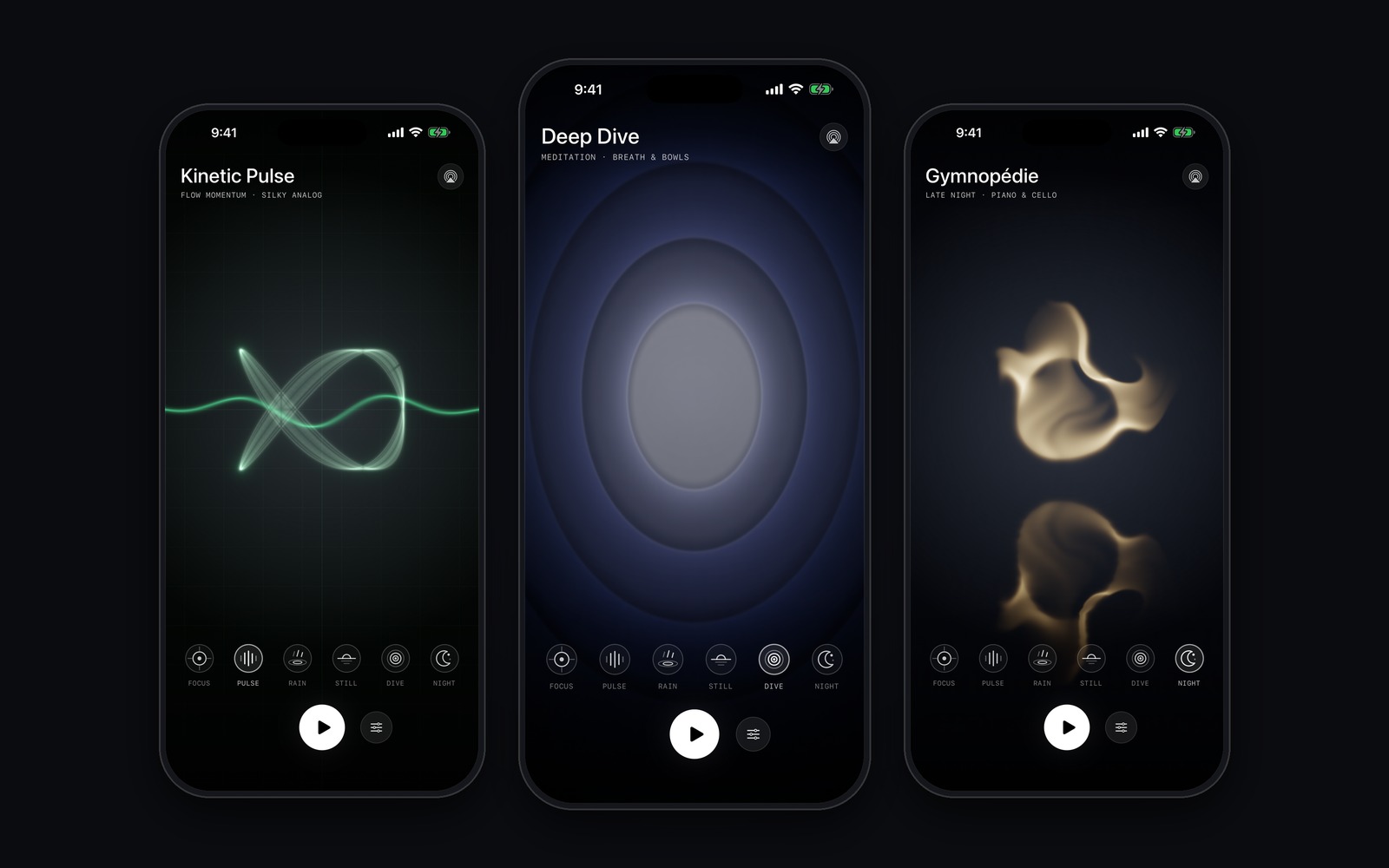
Shipping a real-time Metal and Core Audio instrument on a phone brings constraints that do not exist on a plugged-in MacBook, so I engineered the iOS shell around battery, ergonomics, and system integration:
- Zero-GPU background playback and audio etiquette. With
UIBackgroundModes: audio, synthesis continues uninterrupted when the screen locks, whileiOSAcousticMetalViewpauses rendering to 0% GPU the instantscenePhaseleaves.active. Foreground ProMotion scales automatically from 120 Hz down to 60, 30, or 15 Hz under thermal pressure, Low Power Mode, or Reduce Motion. An opt-in Mix with Other Audio switch (AVAudioSession.CategoryOptions.mixWithOthers) lets Satie sit quietly underneath podcasts or audiobooks, and the audio session handles phone-call interruptions,mediaServicesWereResetrecovery, and AirPods disconnect pauses cleanly. - Dynamic Island, StandBy, and Lock Screen widgets. The embedded
SatieWidgetsextension pairs a pure-OLED bedside StandBy and Home Screen widget (synced with the main app through a local App Group,group.com.strangechances.Satie) with ActivityKit Dynamic Island Live Activities that tick countdowns via Apple's nativetimerIntervalrendering at zero background CPU cost. - Action Button, Siri Shortcuts, and Focus Filters. Native
AppIntentsbind any soundscape or session timer directly to the iPhone Action Button, Shortcuts, Spotlight, and Apple Focus Filters—so Work Focus can start Soft Light automatically, and Sleep or Wind Down Focus can start Deep Dive with nocturnal low-melanopic mode (2200 K ember) engaged on both audio and 06 Oculus. - 8 languages and companion targets. Both the macOS and iOS builds match the device language automatically across English, Japanese, French, Simplified Chinese, Taiwanese Traditional Chinese, Spanish, German, and Korean (including localized App Shortcuts and widgets). In the open-source repository, the same
AcousticCorepackage also powers Apple Watch (SatieWatchwith silent Taptic Breath wrist taps and an optional on-device HealthKit HRV resonance controller that settles pace from 6.97 toward 5.21 bpm without ever sending data off the device), Apple TV (SatieTVin 4K EDR), and Apple Vision Pro (SatieVision).
What it costs, and where it stops
Every number below is measured on Apple Silicon from swift test -c release, the notarized macOS v4.1.1 build, and the universal iOS App Store build:
| Dimension | Measured result |
|---|---|
| Installed footprint | 10.0 MB notarized macOS .dmg (10,509,214 bytes) · 12.0 MB iOS & iPadOS App Store · 46 CC0 files · 8 Apple locales |
| Single-core 48 kHz audio CPU | 1.4% to 5.3% in Deep Dive · 6.6% in Soft Light · 7.7% in Kinetic Pulse · 0% when paused |
| Release invariants (22 tests) | Sub-bass mono correlation > +0.970 · Velvet-Noise FDN DC = 0.000003 · tail flatness = 0.761 · 8-language key parity · 0 dBFS clips |
| GPU & photobiology | 11 Metal pipelines · rgba16Float linear P3 · 68.6% OLED dark area · +44.44 dB blue-noise dither · −90.4% night blue |
| Privacy & permissions | App Sandbox only · 0 macOS privacy prompts · 0 network requests · 0 third-party dependencies |
The tradeoffs are real too, and worth stating plainly:
- Apple platforms only. Satie bets on Core Audio, Swift 6 atomics,
CAMetalDisplayLink, and 16-bit Apple EDR. Porting to Windows or Linux would mean giving up most of what makes the binary 10 MB and zero-allocation. - Six instruments, not a streaming catalog. If you want artist collaborations or real field recordings from Yosemite, Endel and Portal exist for a reason. Satie trades breadth for six quiet rooms you can run offline forever.
- No clinical claims. The 14.40 Hz shimmer and 0.1 Hz breath pacer follow peer-reviewed work, yet Satie is a software instrument, not a medical device. One open empirical question remains unverified locally: whether audio breath pacing alone entrains eyes-closed breathing reliably without watching 06 Oculus, which is why the Watch companion uses HealthKit HRV to close the loop on-device.
You can audition all six soundscapes and the Day/Night visual shift on the Satie page, get it for iPhone & iPad on the App Store, download the notarized macOS build (Satie-4.1.1.dmg), install it via Homebrew (brew install --cask graemecode/tap/satie), or read the full Swift and Metal source on GitHub.
Ambient music must be able to accommodate many levels of listening attention without enforcing one in particular; it must be as ignorable as it is interesting.